
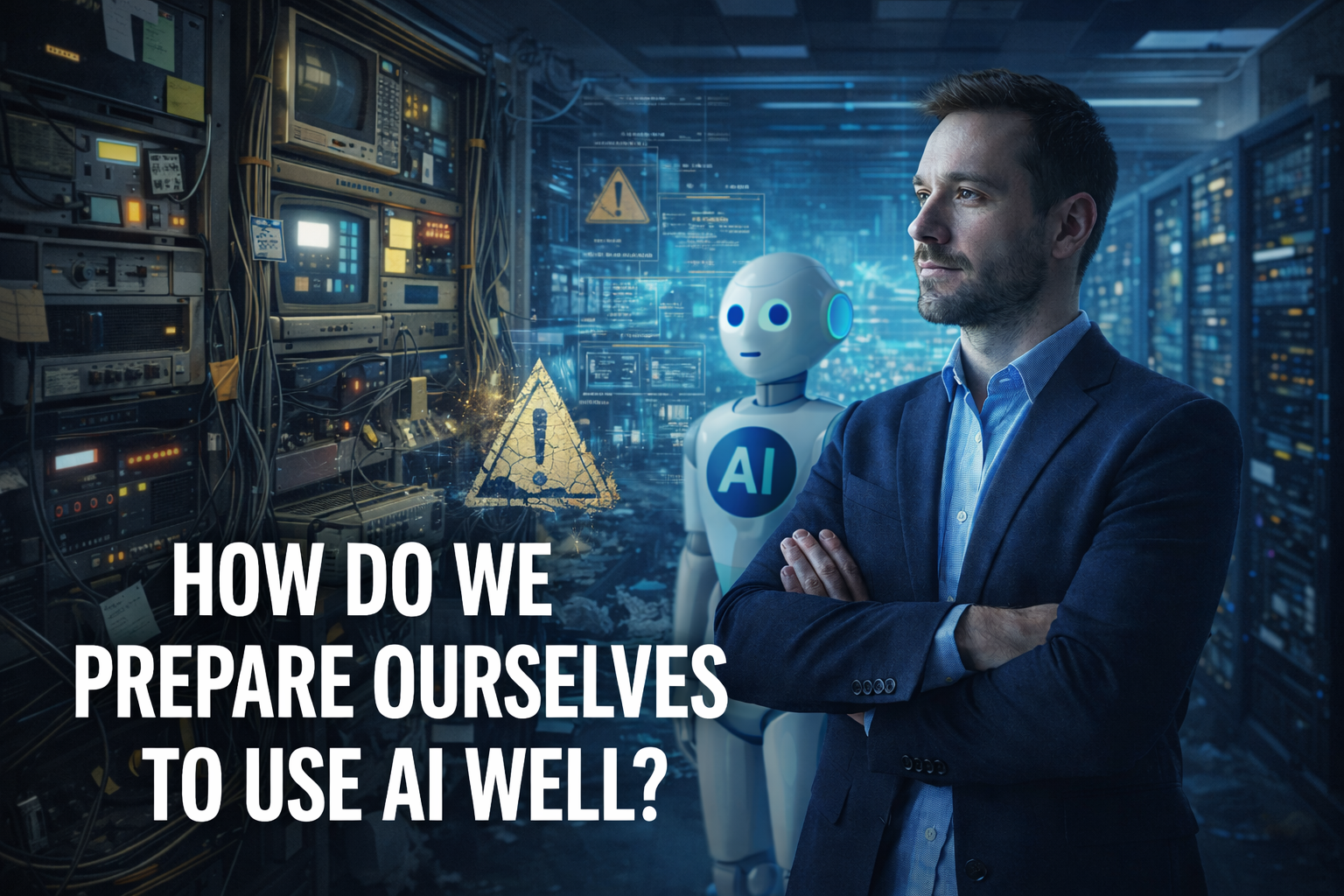
Generative AI has captured the spotlight, our imagination, and most notably funding from nearly every organization around the world. It has been positioned as the greatest innovation in human history by some of the world’s most successful and outspoken CEOs. While also being labeled an existential risk to humanity. There is no doubt that this technology has already begun to change how we live and work, and it stands poised to disrupt nearly everything we do going forward.
Yet, despite all the excitement, I see a growing problem. Most companies large and small are not truly prepared to take advantage of AI’s potential. In fact, many are creating more risk than value in their rush to adopt it.
Just as humans have evolved over thousands of years, Our systems, infrastructures, and institutions have also evolved with us. Our electrical grids, business processes, data storage systems, and communication networks are the result of decades sometimes centuries of incremental development. Each generation built on top of the last. Artificial intelligence is no different. It rests on this accumulated foundation.
And that foundation, in many cases, is the weakest link standing between world-changing innovation and systemic failure.
The Rush to the “Solution”
To understand how we got here, we need to look at our own behavior.
A few years ago, generative AI made its public debut and took the world by storm. It captured our imagination almost instantly. Suddenly, we had access to tools that could write, code, analyze, and create at levels that once seemed impossible.
This technology was introduced by a young company that was deeply focused on building something powerful but not necessarily on defining a specific, narrow problem it was meant to solve. Instead, they created a general-purpose tool that could “do it all,” even if no one yet knew exactly how it would be used.
This was not a problem or a flaw. It was part of the appeal.
They weren’t selling to our current operational realities. They were selling to our human imagination.
The world responded accordingly.
Over the next few years, organizations everywhere tried to fit “the solution” into every problem. Marketing. Compliance. Customer service. Software development. Strategy. HR. Finance. You name it AI was trying to be applied to it.
Some teams saw early successes. While others struggled. Most fell somewhere in between.
And despite the headlines, the true return on investment for AI remains unclear in many industries. Although technology leaders continue to pound the drums advocating for complete adoption.
The Real Problem: Foundations, Not Imagination
The issue is not that generative AI is a fantasy that can never be adopted.
The issue is far more mundane and far more difficult to solution.
We have massive data, architecture, and infrastructure problems that must be solved before AI can truly deliver on its promise.
Our current reality is not limited by our tools.
It is limited by our past.
By decades of shortcuts.
By postponed upgrades.
By temporary fixes that became permanent.
By systems layered on top of systems.
By problems pushed forward “until later.”
Now, later has arrived.
The data bill is on the table, and it must be paid.
Before we can fully unlock the future our imaginations are already racing toward, we must deal with the technical debt, fragmentation, and complexity we’ve accumulated over time.
Without doing this work, AI becomes less of a breakthrough and more of a multiplier of existing dysfunction.
Inside the Average Organization
Consider the average company that has been operating for ten, twenty, or fifty years.
Its technology environment is rarely clean.
Instead, it is usually a patchwork:
- Legacy systems built decades ago
- Proprietary platforms customized beyond recognition
- Modern cloud tools layered on top
- Manual workarounds developed by employees
- Institutional knowledge stored in people’s heads
These environments “work” largely because humans serve as the connectors, translators, and repair technicians when things break.
Employees know which system talks to which.
They know which spreadsheet fixes which report.
They know which process only works on Tuesdays.
This human glue holds everything together.
Now, organizations are trying to plug generative AI into this environment.
An environment held together by digital duct tape and virtual twist ties.
It’s no surprise this is proving difficult.
The Pressure to Perform Innovation
At the executive level, another dynamic is at play: perception.
Leaders are under enormous pressure to appear innovative.
Customers expect it.
Investors demand it.
Boards ask about it.
Competitors talk about it.
So many organizations publicly declare that they are “leveraging AI” not because they truly are, but because they fear what it would mean if they weren’t.
Innovation becomes a marketing message rather than an operational reality.
Customer perception begins to drive strategy more than internal capability.
And that is dangerous.
True innovation does not begin with press releases.
It begins in system design.
In data governance.
In process alignment.
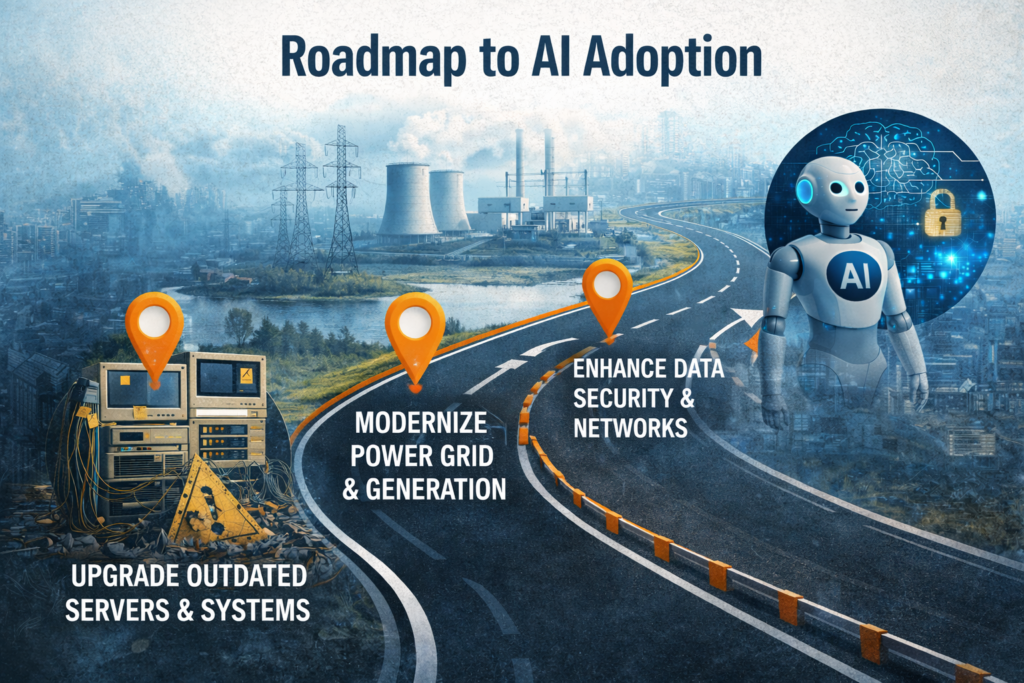
In infrastructure modernization.
It begins at the ground floor.
The Unpopular Work of Real Progress
Real progress requires unglamorous work:
- Cleaning up data
- Standardizing systems
- Retiring outdated platforms
- Redesigning integrations
- Documenting processes
- Reducing complexity
- Rebuilding architecture
This is not exciting.
It doesn’t generate headlines.
It doesn’t inspire viral posts.
It doesn’t impress investors in pitch decks.
But it is essential.
And it is expensive.
At the same time that “shiny” AI technologies are absorbing massive amounts of capital, organizations are being asked to invest heavily in foundational upgrades. This creates tension.
It’s much easier to buy a new AI tool than to reengineer twenty years of infrastructure.
But without that work, the tool will never reach its potential.
National Infrastructure Matters Too
This challenge extends beyond individual companies.
Nation-states face the same reality.
Countries that want to lead in innovation must invest in:
- Digital infrastructure
- Energy reliability
- Network resilience
- Data security
- Education systems
- Regulatory clarity
Modern AI systems cannot thrive in outdated environments.
You cannot run next-generation intelligence on twentieth-century foundations.
We have already seen that countries with strong infrastructure tend to become centers of innovation, entrepreneurship, and economic growth. Those without it fall behind.
AI is an Amplifier for Better or Worse
One of the most important truths about AI is this:
It amplifies whatever environment it is placed in.
If your systems are clean, aligned, and well-governed, AI can accelerate performance.
If your systems are fragmented, outdated, and poorly documented, AI will accelerate chaos.
It will highlight inconsistencies.
It will magnify errors.
It will expose weak governance.
It will automate bad processes.
AI does not fix broken foundations.
It reveals them.
The Path Forward
If organizations want to move beyond hype and toward sustainable value, they must shift their focus.
From:
“How do we use AI?”
To:
“How do we prepare ourselves to use AI well?”
That means:
- Investing in data quality
- Modernizing core systems
- Simplifying architecture
- Strengthening governance
- Aligning technology with strategy
- Building internal capability
Only then does AI become a true strategic asset rather than a risky experiment.
Final Thoughts
Generative AI is real.
Its potential is extraordinary.
Its impact will be lasting.
But it is not magic.
It cannot overcome decades of neglected infrastructure.
It cannot replace disciplined system design.
It cannot compensate for fragmented data.
The future will not be built by organizations that chase every new tool.
It will be built by those willing to do the hard, foundational work first.
By those who understand that sustainable innovation is not about moving fast alone but about building something strong enough to last.
If you liked this article you might want to read this other one it focuses on things you can do to grow in a tech first world.