
Category: Innovation

  • The Creative Edge in an AI-Driven World

    The Creative Edge in an AI-Driven World

    Understanding the creative edge in an AI-driven world, I spend a significant amount of time writing, reading, and speaking about generative AI and the potential it holds for humanity. I truly believe that this technology can help us become more creative, more productive, and ultimately better at the things we care about most. We are standing at the edge of a new way of getting things done. For the first time in history, we have tools that can augment our thinking, accelerate our workflows, and assist us in bringing ideas to life at unprecedented speed.

    However, while I am deeply optimistic about AI as a tool for human advancement, it is becoming increasingly clear that many organizations and leaders are moving in a different direction. Instead of asking how AI can empower people, they are asking how it can replace them. That distinction matters more than most realize. It is what we do today that will have the greatest impact on how we live tomorrow.

    There certainly are tasks AI should handle completely. They are the repetitive ones. The monotonous. The activities that drain our energy and offer little opportunity for growth. Many of us have spent years in roles where large portions of our time were consumed by formatting spreadsheets, cleaning data, summarizing reports, or performing procedural work that, while necessary, did not allow us to think deeply or creatively. AI is exceptionally well suited for those kinds of responsibilities. It does not tire. It does not become bored. It does not crave stimulation. It can handle structure and repetition with remarkable consistency.

    That is where the real opportunity lies.

    If we allow AI to take on the mundane, we free ourselves to focus on the meaningful. We reclaim mental bandwidth. We create space for creativity, strategy, connection, and innovation. Instead of being buried in tasks that “suck the life out of us,” we can redirect our attention toward solving complex problems, imagining all the new possibilities, being able to build things that genuinely move the world forward.

    And yet, even with all the potential this shift is proving to be difficult. Why?

    Humans are creatures of habit. We are wired for stability and familiarity. When something new enters our environment especially something as powerful and disruptive as generative AI, the instinctive reaction is often resistance. We question it. We avoid it. We downplay it. Throughout much of human history, that instinct served us well. Caution and consistency were essential for survival. Venturing too far into the unknown could mean real danger.

    But we are no longer living in a world where our primary threats are physical. We are not running from predators. We are navigating a rapidly evolving digital ecosystem. In this environment, the ability to explore the unknown is not a liability; it is an advantage.

    Some people are naturally wired to chase what others run from. They are curious about emerging technologies. They are comfortable experimenting without having all the answers. They are willing to look foolish in the short term to understand something deeper in the long term. In previous eras, that kind of boldness may not have always been rewarded. But today, it is essential.

    Comfort in the mundane is no longer a sustainable strategy. Consistency in the known is no longer sufficient. Technology is evolving around the clock, and the individuals and organizations that will thrive are those willing to evolve alongside it.

    If you are someone who tends to question the status quo, who enjoys thinking differently, who finds energy in experimentation rather than exhaustion in it, you are already positioned well for what comes next. The next several years will not simply reward technical competence; they will reward adaptability, creative thinking, and the ability to integrate new tools into meaningful work.

    One of the developments that has begun to capture attention recently is something often referred to as “agentic AI.” Many people have heard the term, but far fewer understand what it represents. In simple terms, agentic AI moves beyond chat-based interaction and toward systems that can take action within defined parameters. Instead of merely responding to prompts, these systems can execute workflows, coordinate between tools, and pursue defined objectives with a degree of autonomy.

    It feels like a leap forward, almost like something pulled from a science fiction movie. The idea that software could not only generate ideas but also act on them has captured imaginations quickly. But it is important to remember that these systems are still programs. They must be designed. They must be constrained. They must be monitored. They must be aligned with human intent.

    At least for now, and likely for quite some time humans remain the architects.

    This is where the real edge begins to emerge. There will be those who casually use these tools, and there will be those who invest the time to truly understand how they function. The latter group will shape how these systems evolve. They will be the ones defining workflows, setting guardrails, identifying risks, and uncovering opportunities others miss.

    The competitive advantage will not belong to those who fear AI, nor to those who blindly deploy it in pursuit of short-term efficiency. It will belong to those who approach it with intention. Those who understand that technology is not a substitute for thinking, but rather a catalyst that will allow us to think deeper.

    The question most are asking today is whether AI will replace us? But the more productive question is how will we use AI to multiply our impact?

    We’ve already seen evidence of what happens to our human minds and natural abilities to think if we treat it as a crutch, (HBR What’s Lost When we Work with AI). However, if we treat it as a sparring partner, it can sharpen our minds and enhance everything. If we treat it as a collaborator, it can accelerate what we can build.

    My prediction is that the individuals who focus over the next few years on strengthening their technical literacy, refining their communication skills, and cultivating systems-level thinking will not find themselves displaced. They will find themselves in demand. Organizations will need people who understand both the tools and the human context in which those tools operate.

    Generative AI is not the end of human relevance despite what many may want you to believe. It is a test of our willingness to evolve. It is an invitation to rethink how we spend our time, how we define value, and how we approach creativity.

    The bold thinkers, the experimenters, the ones willing to explore the creative edge in an AI-driven world are not in danger. They are shaping the direction of what comes next. And if you find yourself more curious than fearful, more intrigued than threatened, You might be positioning yourself for a key leadership position in the future.

    The future will not belong to machines alone. It will belong to the humans who learn how to build alongside them.

    If you are interested in learning what I mean by “exploring the edge” check out my article on What is True Innovation.
  • How do we prepare ourselves to use AI well?

    How do we prepare ourselves to use AI well?

    Generative AI has captured the spotlight, our imagination, and most notably funding from nearly every organization around the world. It has been positioned as the greatest innovation in human history by some of the world’s most successful and outspoken CEOs. While also being labeled an existential risk to humanity. There is no doubt that this technology has already begun to change how we live and work, and it stands poised to disrupt nearly everything we do going forward.

    Yet, despite all the excitement, I see a growing problem. Most companies large and small are not truly prepared to take advantage of AI’s potential. In fact, many are creating more risk than value in their rush to adopt it.

    Just as humans have evolved over thousands of years, Our systems, infrastructures, and institutions have also evolved with us. Our electrical grids, business processes, data storage systems, and communication networks are the result of decades sometimes centuries of incremental development. Each generation built on top of the last. Artificial intelligence is no different. It rests on this accumulated foundation.

    And that foundation, in many cases, is the weakest link standing between world-changing innovation and systemic failure.

    The Rush to the “Solution”

    To understand how we got here, we need to look at our own behavior.

    A few years ago, generative AI made its public debut and took the world by storm. It captured our imagination almost instantly. Suddenly, we had access to tools that could write, code, analyze, and create at levels that once seemed impossible.

    This technology was introduced by a young company that was deeply focused on building something powerful but not necessarily on defining a specific, narrow problem it was meant to solve. Instead, they created a general-purpose tool that could “do it all,” even if no one yet knew exactly how it would be used.

    This was not a problem or a flaw. It was part of the appeal.

    They weren’t selling to our current operational realities. They were selling to our human imagination.

    The world responded accordingly.

    Over the next few years, organizations everywhere tried to fit “the solution” into every problem. Marketing. Compliance. Customer service. Software development. Strategy. HR. Finance. You name it AI was trying to be applied to it.

    Some teams saw early successes. While others struggled. Most fell somewhere in between.

    And despite the headlines, the true return on investment for AI remains unclear in many industries. Although technology leaders continue to pound the drums advocating for complete adoption.

    The Real Problem: Foundations, Not Imagination

    The issue is not that generative AI is a fantasy that can never be adopted.

    The issue is far more mundane and far more difficult to solution.

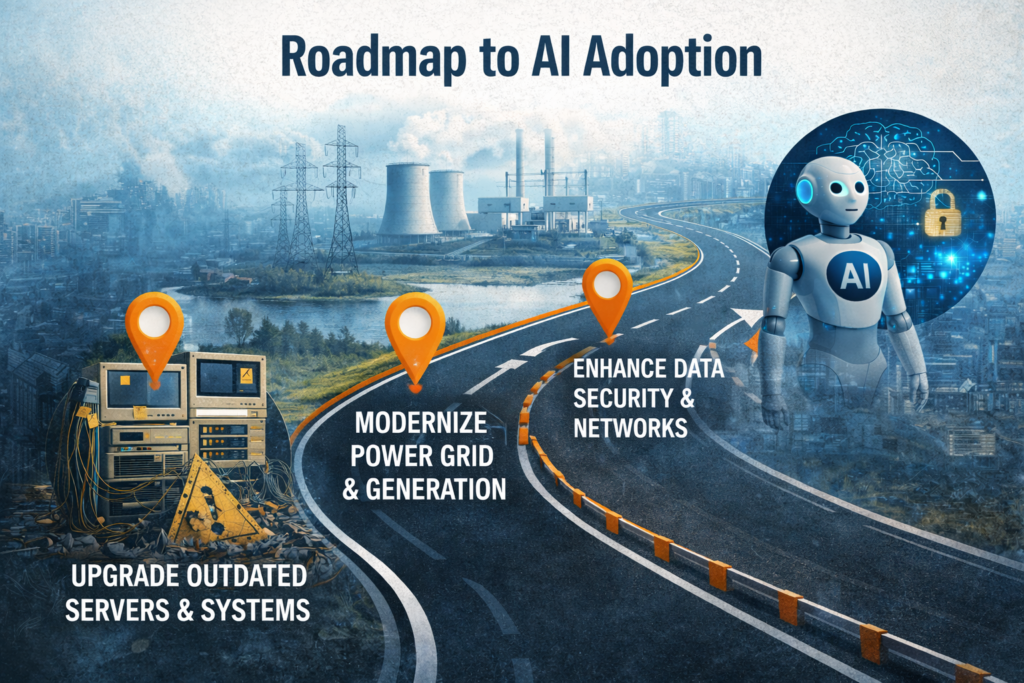
    We have massive data, architecture, and infrastructure problems that must be solved before AI can truly deliver on its promise.

    Our current reality is not limited by our tools.

    It is limited by our past.

    By decades of shortcuts.
    By postponed upgrades.
    By temporary fixes that became permanent.
    By systems layered on top of systems.
    By problems pushed forward “until later.”

    Now, later has arrived.

    The data bill is on the table, and it must be paid.

    Before we can fully unlock the future our imaginations are already racing toward, we must deal with the technical debt, fragmentation, and complexity we’ve accumulated over time.

    Without doing this work, AI becomes less of a breakthrough and more of a multiplier of existing dysfunction.

    Inside the Average Organization

    Consider the average company that has been operating for ten, twenty, or fifty years.

    Its technology environment is rarely clean.

    Instead, it is usually a patchwork:

    • Legacy systems built decades ago
    • Proprietary platforms customized beyond recognition
    • Modern cloud tools layered on top
    • Manual workarounds developed by employees
    • Institutional knowledge stored in people’s heads

    These environments “work” largely because humans serve as the connectors, translators, and repair technicians when things break.

    Employees know which system talks to which.
    They know which spreadsheet fixes which report.
    They know which process only works on Tuesdays.

    This human glue holds everything together.

    Now, organizations are trying to plug generative AI into this environment.

    An environment held together by digital duct tape and virtual twist ties.

    It’s no surprise this is proving difficult.

    The Pressure to Perform Innovation

    At the executive level, another dynamic is at play: perception.

    Leaders are under enormous pressure to appear innovative.

    Customers expect it.
    Investors demand it.
    Boards ask about it.
    Competitors talk about it.

    So many organizations publicly declare that they are “leveraging AI” not because they truly are, but because they fear what it would mean if they weren’t.

    Innovation becomes a marketing message rather than an operational reality.

    Customer perception begins to drive strategy more than internal capability.

    And that is dangerous.

    True innovation does not begin with press releases.
    It begins in system design.
    In data governance.
    In process alignment.
    In infrastructure modernization.

    It begins at the ground floor.

    The Unpopular Work of Real Progress

    The Unpopular Work of Real Progress

    Real progress requires unglamorous work:

    • Cleaning up data
    • Standardizing systems
    • Retiring outdated platforms
    • Redesigning integrations
    • Documenting processes
    • Reducing complexity
    • Rebuilding architecture

    This is not exciting.

    It doesn’t generate headlines.
    It doesn’t inspire viral posts.
    It doesn’t impress investors in pitch decks.

    But it is essential.

    And it is expensive.

    At the same time that “shiny” AI technologies are absorbing massive amounts of capital, organizations are being asked to invest heavily in foundational upgrades. This creates tension.

    It’s much easier to buy a new AI tool than to reengineer twenty years of infrastructure.

    But without that work, the tool will never reach its potential.

    National Infrastructure Matters Too

    This challenge extends beyond individual companies.

    Nation-states face the same reality.

    Countries that want to lead in innovation must invest in:

    • Digital infrastructure
    • Energy reliability
    • Network resilience
    • Data security
    • Education systems
    • Regulatory clarity

    Modern AI systems cannot thrive in outdated environments.

    You cannot run next-generation intelligence on twentieth-century foundations.

    We have already seen that countries with strong infrastructure tend to become centers of innovation, entrepreneurship, and economic growth. Those without it fall behind.

    AI is an Amplifier for Better or Worse

    One of the most important truths about AI is this:

    It amplifies whatever environment it is placed in.

    If your systems are clean, aligned, and well-governed, AI can accelerate performance.

    If your systems are fragmented, outdated, and poorly documented, AI will accelerate chaos.

    It will highlight inconsistencies.
    It will magnify errors.
    It will expose weak governance.
    It will automate bad processes.

    AI does not fix broken foundations.

    It reveals them.

    The Path Forward

    If organizations want to move beyond hype and toward sustainable value, they must shift their focus.

    From:
    “How do we use AI?”

    To:
    “How do we prepare ourselves to use AI well?”

    That means:

    • Investing in data quality
    • Modernizing core systems
    • Simplifying architecture
    • Strengthening governance
    • Aligning technology with strategy
    • Building internal capability

    Only then does AI become a true strategic asset rather than a risky experiment.

    Final Thoughts

    Generative AI is real.
    Its potential is extraordinary.
    Its impact will be lasting.

    But it is not magic.

    It cannot overcome decades of neglected infrastructure.
    It cannot replace disciplined system design.
    It cannot compensate for fragmented data.

    The future will not be built by organizations that chase every new tool.

    It will be built by those willing to do the hard, foundational work first.

    By those who understand that sustainable innovation is not about moving fast alone but about building something strong enough to last.

    If you liked this article you might want to read this other one it focuses on things you can do to grow in a tech first world.

  • The Digital World needs Leadership not Management

    The Digital World needs Leadership not Management

    Between 1760 and 1840, the world witnessed one of the most transformative periods in human history: the First Industrial Revolution. This era introduced steam power, mechanized production, and a seismic shift from agrarian lifestyles to industrialized economies. It was a time of great upheaval and opportunity, as people moved away from farms and into factories in search of new work and “stability”. For the first time, large groups of people came together under one roof, performing repetitive tasks in coordination with machines, not the seasons.

    Almost a century later, the Second Industrial Revolution reshaped the world again. Electricity became widely available, and mass production techniques like Henry Ford’s revolutionary assembly line ushered in an era of unprecedented efficiency. Factories became larger, output skyrocketed, and the need to coordinate human labor in these massive systems gave rise to something new: management.

    Management, as a formal function, was born out of necessity. Workers needed oversight. Processes needed to be standardized. Resources had to be tracked and optimized. Managers were tasked with ensuring that production was consistent, that employees followed instructions, and that the system continued to function smoothly. This “command and control” approach to organizational structure worked well in an era where predictability, repetition, and stability were the keys to success.

    And for over 200 years, it remained largely unchallenged.

    But the world has changed dramatically! So must the way we lead teams and organizations.

    The tools, systems, and structures designed to optimize the industrial workforce are showing their age. We no longer operate in a world of predictable outcomes and linear processes. The digital era accelerated by cloud computing, artificial intelligence, remote work, and global connectivity has fundamentally changed the way we work, communicate, and create value. Today’s economy is driven not by compliance and repetition, but by creativity, adaptability, and collaboration.

    And yet, most organizations are still relying on management models built for factories, not digital ecosystems.

    We are now in the early stages of what many are calling the Fourth Industrial Revolution an era defined by automation, big data, generative AI, and the fusion of digital, biological, and physical systems. In this new world, speed, innovation, and responsiveness matter more than rigid hierarchies and process control. Employees are no longer simply cogs in a machine they are knowledge workers, creators, problem-solvers, and relationship-builders. The rules have changed.

    But for the majority of companies and organization around the world the “leadership” models that have been established have not caught up.

    Most companies continue to invest in management systems designed to maintain control, enforce compliance, and drive efficiency. While these goals are not inherently wrong, they are no longer sufficient. The digital world requires something more: it needs Real Leadership

    Real leadership.

    Leadership that empowers teams rather than oversees them. Leadership fostering trust, psychological safety, and autonomy. Leadership that encourages experimentation, lifelong learning, and adaptability in the face of uncertainty.

    The disconnect has been growing for decades, but it was often overlooked masked by short-term gains and organizational inertia. Addressing it will require a deep cultural shift, a rethinking of power dynamics, and a willingness to question long-held assumptions. For many, that’s been a bridge too far.

    But the digital transformation wave and now, the AI revolution is forcing a reckoning. Leaders can no longer manage their way into the future. The pace of change is too fast. The demands of today’s workforce are very different. And the opportunities of tomorrow will belong to those who can inspire, guide, and elevate not just instruct and enforce.