
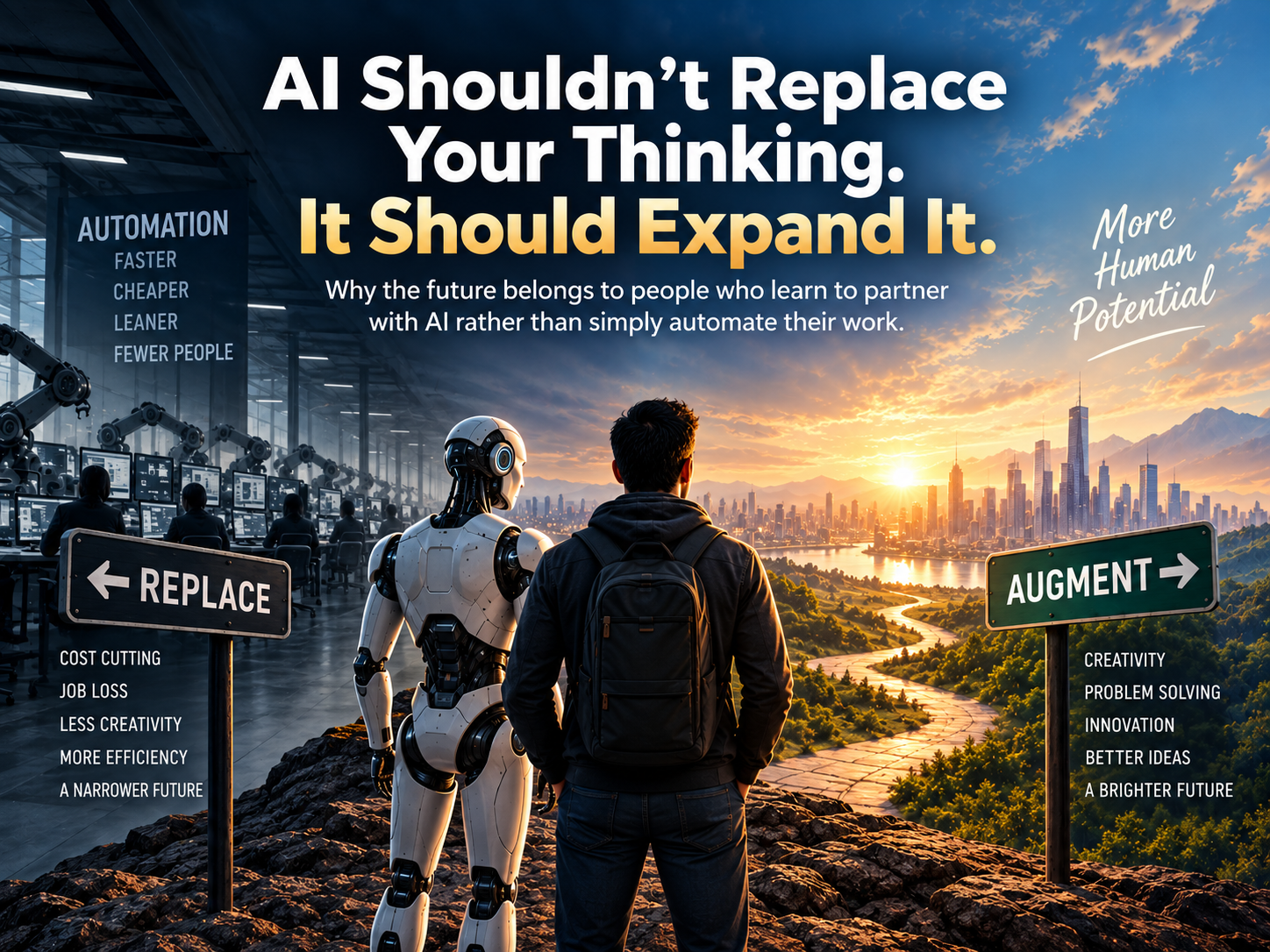
Why the future belongs to those who learn to partner with AI rather than simply automate their work.
I have always seen Artificial Intelligence as a tool you can partner with to expand your thoughts and abilities. I’ve written about this many times over the past few years, and now it is becoming clear that we are standing at a critical crossroads in how we think about and use AI.
The first path is clear, and it seems this is the one many are taking without fully considering the impact and consequences.
Companies are racing to automate as much as they can. The reasoning is straightforward: AI can perform work faster, cheaper, and at greater scale than people. Tasks that once required hours can be completed in minutes. Processes that required entire teams can increasingly be handled by software. Work that once required significant amounts of human effort can now be completed with a fraction of the time and resources.
They see this as an “easy” way to increase profits.
But there is a danger in assuming that the ultimate goal of AI is to eliminate as much human effort as possible. Society and work are not simply a collection of tasks that can be broken down into workflows and automated one by one.
Some of the most valuable things people do cannot be reduced to workflows, diagrams, or automated with a prompt. You, interpret ambiguity. You recognize patterns. You challenge assumptions. You understand context. You make judgments when there isn’t a clear right answer. You imagine what could exist before there is evidence that it should. You connect seemingly unrelated ideas and create something new from them. This is how you have been able to accomplish most of the things you have today and how all of us have been able to build the society we live in.
The second path is not as clear yet, although it is there, and this is where I see the difference between automation and augmentation.
Instead of viewing AI primarily as a replacement for human effort, it should be seen as a force multiplier for human thinking. AI has the capability to expand how you think without replacing your thoughts. AI is a tool that can take on the mundane tasks that must be done but drain your energy and mental capacity. It is a tool that you can leverage to brainstorm and iterate on micro proof-of-concepts to improve processes. Ultimately, it is a tool that can minimize your mental workload while enhancing and fostering your creativity, something that has been demonstrated throughout history to lead to greater levels of innovation and advancement.
Think about what happens when you remove the unnecessary friction from someone’s day. A person who previously spent hours formatting information, searching through documents, cleaning data, writing repetitive communications, or completing other administrative tasks suddenly has that time back. That person now has the opportunity to think about the customer, solve a difficult problem, build something new, or simply explore an idea that they would not have had the time or energy to pursue before.
This is the path I believe you should be pursuing, and it can also be a dangerous one because it walks a fine line where critical thinking could easily be outsourced if you, as the human users, aren’t careful. Over the past six years, as I’ve been testing the available tools and models, I’ve seen how companies developing these technologies are making it increasingly easy for the AI tool to push its way into becoming the thinker rather than simply the processor.
The argument they make for this is valid because if the model can take over some of the thinking tasks, it will be more helpful. The more work the tool can complete for you, the more valuable it appears to become. However, the you as the user need to remain alert and intentional so that you don’t simply follow where the AI model is going instead of leading it toward your own unique thoughts, ideas, and perspectives.
This distinction may seem small, but I believe it will become incredibly important. There is a major difference between asking AI to help you think through a problem and asking AI to think about the problem for you. There is a difference between using AI to challenge your assumptions and using it to make your decisions. There is a difference between using AI to expand your imagination and allowing it to define the boundaries of your imagination.
I believe this will become one of the defining distinctions between those who merely implement AI and those who adopt it, learn how to work with it effectively, and ultimately thrive because of it.
Now that I’ve outlined the two paths and how you should be looking at AI adoption and implementation, let’s dive into the framework for how to reach this new level.
Until recently, there have only been two levels of AI users.
Level 1: Chat Bot mode
This is where we all start playing around with these tools as a novelty, testing the waters for what they can do. Many early questions were simple and awkward. Random questions that were meant more as a test rather than an actual inquiry. “Tell me about the solar system?” or “How do you spell strawberry?” While these questions were helpful because it meant you were willing to try out the tool rather than simply ignore it, they barely scratched the surface.
There was something important about this first stage, though. People were beginning to interact with technology in a completely different way. Instead of learning a specific command or navigating through a series of menus, we could simply ask the computer a question using natural language. For many people, this was the first time technology actually felt like something they could talk to rather than something they had to learn how to operate.
Level 2: Search Bot mode
This is where most people currently are and tend to stay because this is how they have always interacted with computers. They use AI models as a search engine: “Find me how to make chocolate chip cookies,” or “What year did NASA retire the space shuttle program?” While this is extremely helpful for quickly getting answers to questions you might have personally, for school, or because you have a bet with a friend, it is still a fraction of what AI can really do.
The problem with remaining in this stage is that you are still treating AI as an improved version of a tool we have already been using for decades. You are essentially asking a new technology to perform an old task better. There is certainly value in that, but it doesn’t take advantage of what makes these systems fundamentally different.
The real opportunity begins when we stop simply asking AI for answers and start using it as a partner in the process of thinking.
Level 3: Brainstorming Partner mode
This level has recently been unlocked, within the past two years, with the release of newer and more advanced models, and it is a level where I believe you need to make sure you reach. At this level, you will work with AI not simply to review its work and be the “human in the loop,” but rather to have it help you develop your ideas.
Bring your thoughts to life and show how you can supercharge your uniqueness. This is how you will increase the value you provide to your own business, to your employer, or to your customers.
The difference here is subtle but extremely important. You are no longer asking AI to give you the answer. You are asking it to help you explore the problem.
You might bring an idea to the model that is only half formed and ask it to challenge you. You might ask it to identify weaknesses in your argument, suggest perspectives you haven’t considered, or help you develop multiple approaches to a problem. You might use it to create a quick proof of concept that allows you to see whether an idea is even worth pursuing.
The AI becomes a thinking partner rather than a replacement for thinking.
An interesting example of this comes from Utah’s Jordan School District. (Full Yahoo article here)
Over a two-year period, researchers analyzed nearly 14,000 student-to-AI conversations involving 82 teachers. Rather than simply allowing students to use AI as a shortcut for producing answers, the district emphasized intentional use of the technology as a “thought partner.”
The reported result were striking: students demonstrated a 28% increase in critical-thinking performance, while higher-level reasoning abilities more than doubled across the subjects and grade levels studied.
The important takeaway isn’t that AI magically made students smarter.
It is almost the opposite.
The technology was deliberately designed and used to make students think.
The AI wasn’t there to remove the cognitive work.
It was there to stimulate it.
That distinction should matter far beyond education.
Because organizations are now facing the same choice.
Do we use AI to eliminate thinking?
Or do we use AI to elevate it?
This two-year experiment across nearly 14,000 students highlights the potential advanced AI models can have for innovation and productivity in the future. However, the key to the success of this program, I believe, was the intentionality of the guardrails the students were given to ensure they were leading the thought process and not simply outsourcing it.
This is where I believe the future of AI gets really interesting.
Imagine what happens when every person in an organization has access to a tool that can help them brainstorm, research, challenge assumptions, build prototypes, analyze information, and explore possibilities. Imagine a first-year employee having access to a tool that can help them understand an unfamiliar problem while still requiring them to make the final judgment. Imagine an experienced executive being able to test an idea against dozens of perspectives before bringing it to their leadership team. Imagine a designer, engineer, teacher, writer, analyst, or entrepreneur being able to experiment with ideas at a speed that would have been impossible just a few years ago.
That is augmentation.
It isn’t about removing the human from the process. It is about giving the human more capability.
This is also why I believe you need to be careful about how you measure the success of AI adoption. If the only metric you use is how many employees can be removed from a process, then you are going to miss the much larger opportunity. You should also be asking how many new ideas were created, how many problems were solved, how quickly prototypes were developed, how much time employees gained back, and what people were able to accomplish that previously wasn’t possible.
If AI gives someone ten additional hours a week, the question shouldn’t simply be, “How much more work can we make them do?”
The better question is, “What could they create with those ten hours?”
That is the question that will determine whether you use AI to simply make your existing systems more efficient or whether you use it to fundamentally change what is possible.
I believe the greatest opportunity in front of you is not to build a world where humans do less. It is to build a world where humans can do more of what actually makes us valuable.
You should allow AI to take the repetitive work. You should allow it to help you organize information, analyze massive datasets, generate initial concepts, test ideas, and build things faster. But you should remain responsible for deciding what matters, why it matters, and where we want to go.
The technology should help you get there faster.
It should not decide where you are going.
That distinction is going to become increasingly important as AI systems become more capable. The more powerful the tool becomes, the easier it will be to hand over pieces of your thinking without even realizing you are doing it. The temptation will always be there because it is convenient. If a machine can make the decision for you, why spend the time thinking about it yourself?
Because the act of thinking is part of what makes you human.
It is how you learn. It is how you develop judgment. It is how you create new ideas. It is how you discover things that nobody has discovered before.
You should not be afraid of AI becoming more capable. You should be afraid of becoming less capable because you stopped using your own abilities.
The future I want to see is not one where AI replaces humans.
It is one where humans become significantly more capable because AI exists.
That is the difference between automation and augmentation.
And I believe the people and organizations that understand that difference will be the ones that truly thrive in an AI-driven world.
If you liked this article check out “The Creative Edge in an AI-Driven World” an article I wrote earlier in the year.
Leave a Reply