Tag: Entrepreneur

  • The Creative Edge in an AI-Driven World

    The Creative Edge in an AI-Driven World

    Understanding the creative edge in an AI-driven world, I spend a significant amount of time writing, reading, and speaking about generative AI and the potential it holds for humanity. I truly believe that this technology can help us become more creative, more productive, and ultimately better at the things we care about most. We are standing at the edge of a new way of getting things done. For the first time in history, we have tools that can augment our thinking, accelerate our workflows, and assist us in bringing ideas to life at unprecedented speed.

    However, while I am deeply optimistic about AI as a tool for human advancement, it is becoming increasingly clear that many organizations and leaders are moving in a different direction. Instead of asking how AI can empower people, they are asking how it can replace them. That distinction matters more than most realize. It is what we do today that will have the greatest impact on how we live tomorrow.

    There certainly are tasks AI should handle completely. They are the repetitive ones. The monotonous. The activities that drain our energy and offer little opportunity for growth. Many of us have spent years in roles where large portions of our time were consumed by formatting spreadsheets, cleaning data, summarizing reports, or performing procedural work that, while necessary, did not allow us to think deeply or creatively. AI is exceptionally well suited for those kinds of responsibilities. It does not tire. It does not become bored. It does not crave stimulation. It can handle structure and repetition with remarkable consistency.

    That is where the real opportunity lies.

    If we allow AI to take on the mundane, we free ourselves to focus on the meaningful. We reclaim mental bandwidth. We create space for creativity, strategy, connection, and innovation. Instead of being buried in tasks that “suck the life out of us,” we can redirect our attention toward solving complex problems, imagining all the new possibilities, being able to build things that genuinely move the world forward.

    And yet, even with all the potential this shift is proving to be difficult. Why?

    Humans are creatures of habit. We are wired for stability and familiarity. When something new enters our environment especially something as powerful and disruptive as generative AI, the instinctive reaction is often resistance. We question it. We avoid it. We downplay it. Throughout much of human history, that instinct served us well. Caution and consistency were essential for survival. Venturing too far into the unknown could mean real danger.

    But we are no longer living in a world where our primary threats are physical. We are not running from predators. We are navigating a rapidly evolving digital ecosystem. In this environment, the ability to explore the unknown is not a liability; it is an advantage.

    Some people are naturally wired to chase what others run from. They are curious about emerging technologies. They are comfortable experimenting without having all the answers. They are willing to look foolish in the short term to understand something deeper in the long term. In previous eras, that kind of boldness may not have always been rewarded. But today, it is essential.

    Comfort in the mundane is no longer a sustainable strategy. Consistency in the known is no longer sufficient. Technology is evolving around the clock, and the individuals and organizations that will thrive are those willing to evolve alongside it.

    If you are someone who tends to question the status quo, who enjoys thinking differently, who finds energy in experimentation rather than exhaustion in it, you are already positioned well for what comes next. The next several years will not simply reward technical competence; they will reward adaptability, creative thinking, and the ability to integrate new tools into meaningful work.

    One of the developments that has begun to capture attention recently is something often referred to as “agentic AI.” Many people have heard the term, but far fewer understand what it represents. In simple terms, agentic AI moves beyond chat-based interaction and toward systems that can take action within defined parameters. Instead of merely responding to prompts, these systems can execute workflows, coordinate between tools, and pursue defined objectives with a degree of autonomy.

    It feels like a leap forward, almost like something pulled from a science fiction movie. The idea that software could not only generate ideas but also act on them has captured imaginations quickly. But it is important to remember that these systems are still programs. They must be designed. They must be constrained. They must be monitored. They must be aligned with human intent.

    At least for now, and likely for quite some time humans remain the architects.

    This is where the real edge begins to emerge. There will be those who casually use these tools, and there will be those who invest the time to truly understand how they function. The latter group will shape how these systems evolve. They will be the ones defining workflows, setting guardrails, identifying risks, and uncovering opportunities others miss.

    The competitive advantage will not belong to those who fear AI, nor to those who blindly deploy it in pursuit of short-term efficiency. It will belong to those who approach it with intention. Those who understand that technology is not a substitute for thinking, but rather a catalyst that will allow us to think deeper.

    The question most are asking today is whether AI will replace us? But the more productive question is how will we use AI to multiply our impact?

    We’ve already seen evidence of what happens to our human minds and natural abilities to think if we treat it as a crutch, (HBR What’s Lost When we Work with AI). However, if we treat it as a sparring partner, it can sharpen our minds and enhance everything. If we treat it as a collaborator, it can accelerate what we can build.

    My prediction is that the individuals who focus over the next few years on strengthening their technical literacy, refining their communication skills, and cultivating systems-level thinking will not find themselves displaced. They will find themselves in demand. Organizations will need people who understand both the tools and the human context in which those tools operate.

    Generative AI is not the end of human relevance despite what many may want you to believe. It is a test of our willingness to evolve. It is an invitation to rethink how we spend our time, how we define value, and how we approach creativity.

    The bold thinkers, the experimenters, the ones willing to explore the creative edge in an AI-driven world are not in danger. They are shaping the direction of what comes next. And if you find yourself more curious than fearful, more intrigued than threatened, You might be positioning yourself for a key leadership position in the future.

    The future will not belong to machines alone. It will belong to the humans who learn how to build alongside them.

    If you are interested in learning what I mean by “exploring the edge” check out my article on What is True Innovation.
  • The Future of Humanity is Still Human

    The Future of Humanity is Still Human

    Technology doesn’t scare me.

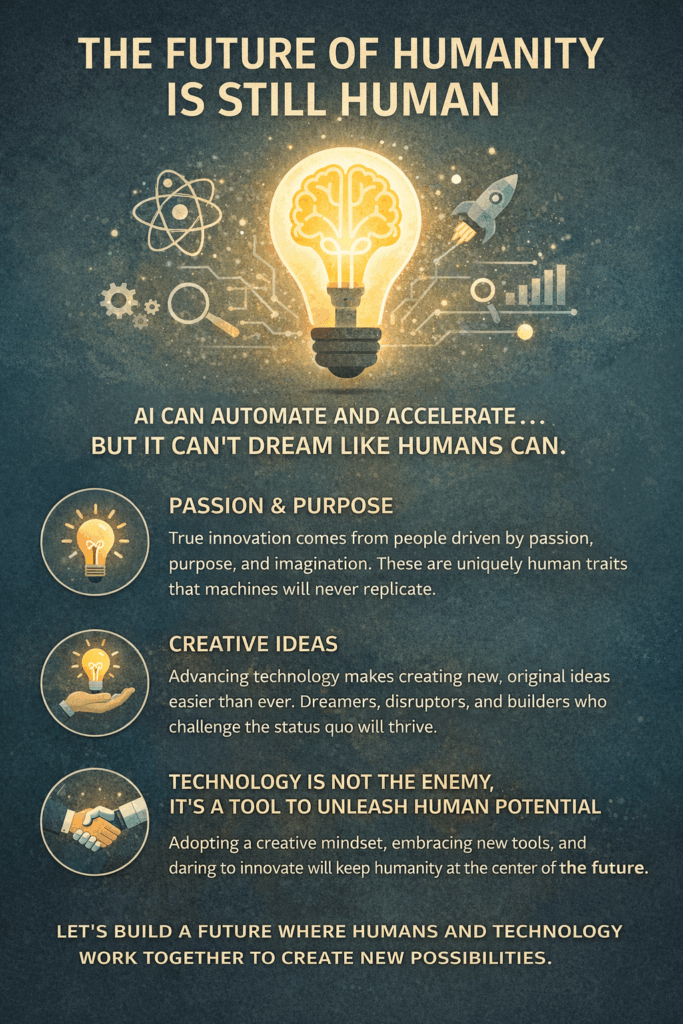
    I’ve never been afraid of losing my place in the world to a machine, and here’s why: no matter how advanced computers become, they will never be able to replicate the imagination, passion, and ingenuity of a person chasing down a problem that truly matters to them.

    Machines can analyze, automate, and accelerate but they cannot dream. They can’t yearn, nor can they deeply care. At least not in the way humans do. Passion and purpose are still uniquely human traits and they remain at the heart of all meaningful innovations.

    The Spark That Machines Lack

    We are living in a time where artificial intelligence and automation are evolving at breakneck speed. And yet, in that race to build faster, smarter systems, it seems like society has begun to lose something: our sense of originality.

    Movies are mostly sequels or reboots. “New” product releases are often just minor upgrades with marketing hype. Phones get a slightly better camera, and that’s considered innovation. But let’s be honest, that’s not innovation. That’s iteration.

    And this,this world of safe, recycled ideas is what AI is best positioned to replace.

    But those who dare to do things differently? Those who look at the way something has always been done and say, “We can do better”? The dreamers, the disruptors, the builders will be in demand in this new future. These are the individuals who will thrive.

    A Shift in the Creative Model

    If you want to stay relevant and not just survive but thrive you must start learning how to see the world not as it is, but as it could be.

    For decades, creation at scale was reserved for massive corporations. To bring an idea to life, you needed funding, infrastructure, and an army of employees. So most people, even the most creative ones, stepped into narrow roles to support someone else’s vision.

    But that world is changing.

    Today, thanks to the democratization of technology, the barriers to creation are lower than ever. A person with a product idea can prototype it using 3D printing. Artists can design merchandise and print it only when someone orders. You no longer need to build a factory you need an idea, access to the right tools, and the courage to act.

    We are living in an era where you don’t need to wait for permission. You don’t need a massive team. You just need a spark.

    And we need to remember that we can still be the ones holding the match.

    Technology Is Not the Enemy

    Let this be a wake-up call: Technology is not here to replace us. It’s here to elevate us.

    AI can do one of two things:

    • It can destroy our sense of purpose by taking over task’s others assigned us…
    • Or it can liberate us to chart our own course, solve problems we truly care about, and create things the world has never seen.

    The difference lies in mindset.

    If you define your value by your ability to follow instructions or complete repetitive tasks, the future will feel threatening. But if your value comes from your perspective, your creativity, your unique way of seeing the world then AI becomes your amplifier, not your rival.

    The Challenge Ahead

    This shift won’t be easy. It will be uncomfortable. It will force us to reimagine what “work” means, and it will challenge every assumption we’ve held about how careers are supposed to work.

    But it will also open the door for many who’ve long felt stuck in the grind.

    We’re entering a new age where the power to build, launch, and scale ideas no longer belongs solely to the privileged few. The tools of innovation are now within reach. But the real question is do you still believe you can innovate?

    Can you let go of what’s always been and embrace what could be?

    Because the future is still human. It always has been.

    And it needs those humans now more than ever.

  • Setup for Success Creating Clarity in Business

    Setup for Success Creating Clarity in Business

    As the world moves faster than ever and is becoming more interconnected by the day, founders can no longer afford to operate, with an outdated mindset. To build something lasting, they must learn to focus, lead with intention, and approach their organizations differently from the start.

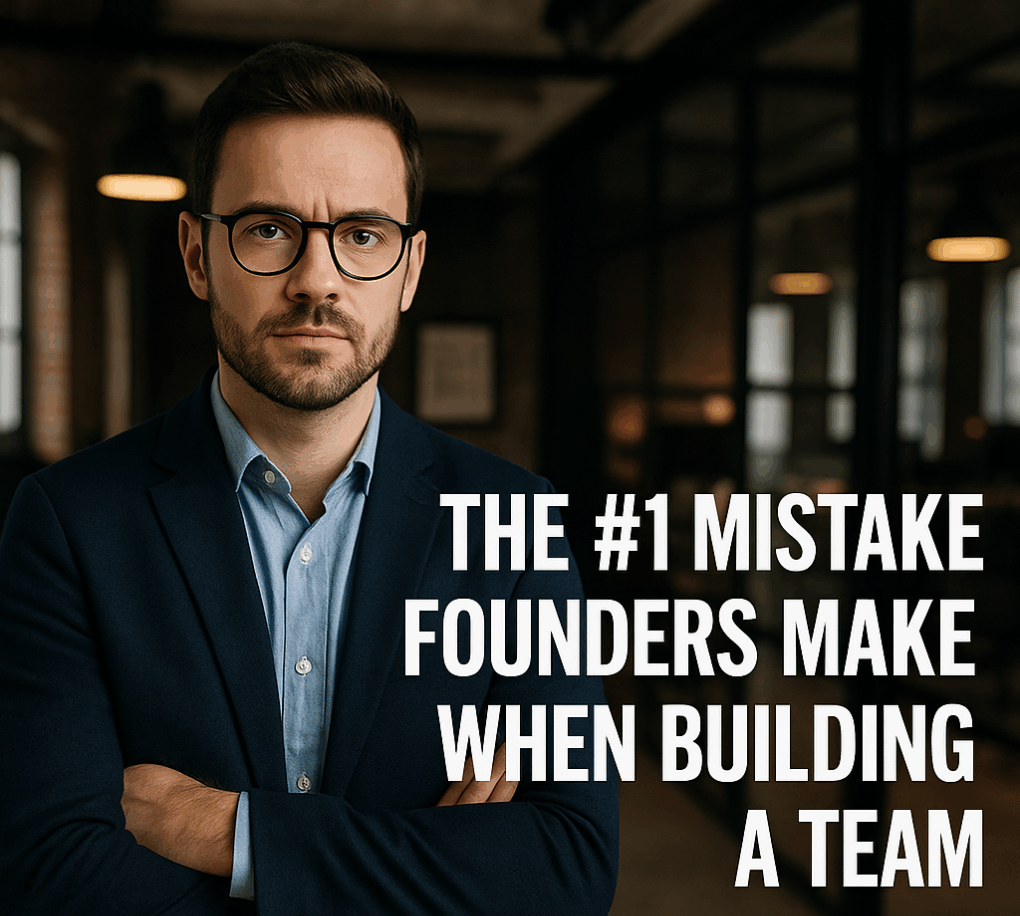
    The #1 Mistake Founders Make When Building a Team

    One of the most common mistakes I see founders make time and time again is failing to establish a clear vision for the type of organizational structure they want to foster. Too often, leaders bounce from one management style to another because:

    1. They’re chasing what’s currently trending in startup culture.
    2. They haven’t taken the time to define how they want to engage with their employees.
    3. They try to be liked by everyone, employees, customers, investors without realizing that clarity, not popularity, breeds success.

    This lack of clarity leads to inconsistency, confusion, and ultimately, failure. An unclear organizational structure erodes trust, creates misaligned expectations, and makes it nearly impossible to scale sustainably.

    So how do you avoid this trap?

    Step One: Know Your Options

    Start by familiarizing yourself with the different organizational mindsets. Then, map out your own leadership goals. Ask yourself:

    • How do I want to be perceived by my team?
    • What do I want our customers to say about us when we’re not in the room?
    • What values do I want to be at the core of this company today and in the future?

    Once you answer these questions honestly, you can begin to align your internal operations and team structure accordingly.

    While there are countless ways to slice organizational design, I’ve found it helpful to begin with two foundational archetypes. These aren’t mutually exclusive, but understanding them can help bring clarity to your leadership style and company culture.

    Organizational Mindset #1: Mission-Focused (The Believers)

    This is the founder who is on a mission to change the world or at least a piece of it. Your company exists for a larger purpose, and your team is made up of people who genuinely believe in that mission. These aren’t just employees, they’re co-creators.

    In mission-focused organizations:

    • Team members feel a strong sense of ownership and emotional investment.
    • People naturally take the initiative because they care about the impact of their work.
    • There’s a shared understanding that everyone is building something that matters.

    This model tends to work especially well in the early stages of a company, when small, nimble teams need to move fast and think big. It’s not hard to motivate your team when they’re personally connected to the “why” behind what you’re doing.

    However, mission-driven models require strong alignment. If your mission is vague, disconnected from day-to-day work, or inconsistently communicated, it can quickly fall apart.

    Organizational Mindset #2: Customer-Focused (The Service First Team)

    In this model, customer satisfaction is the north star. Every team member, from marketing to product to support, rallies around delivering the best possible experience for the end user.

    What defines this structure is a relentless focus on the customer:

    • Success is measured in smiles, five-star reviews, and repeat business.
    • Employees are driven by the feedback loop of delighting customers.
    • Processes are constantly refined to improve service and simplify the customer journey.

    Customer-focused companies often develop strong reputations in the market and fast. Employees don’t necessarily have to be passionate about the product itself; they’re passionate about solving problems and making the customer feel valued.

    The challenge with this model is internal alignment. If you’re not careful, your team can lose sight of the company’s broader vision, leading to short-term thinking and reactive behavior. Clear communication and strong leadership are essential to maintaining focus and cohesion.

    Why It Matters

    Whether you lean more toward a mission-focused or customer-focused model (or a blend of both), the key is clarity. When your organizational structure aligns with your values, it becomes easier to:

    • Hire people who are the right fit.
    • Make decisions faster and more confidently.
    • Empower employees to take action without second-guessing themselves.
    • Scale culture and operations without losing your identity.

    There’s no one-size-fits-all solution. What matters most is that you are intentional about how you lead and build. Take the time to define your structure early and revisit it often as your company grows.